The Control Plane: Steering your Agents
Stop jumping straight into code. To ship production-grade software with AI agents without endless refactoring, you need a control plane. Here is how to use predev to decompress raw ideas into an autonomous, parallelized agent execution pipeline.

From Raw Idea to Autonomous Execution with predev
We all love the rush of jumping straight into a codebase. Writing code feels like instant progress. But if you want to ship production-grade software with coding agents without getting trapped in endless refactoring, you have to start at the planning layer.
Whether you are building with a team of human engineers or a flock of agents, the winning strategy requires a shift from managing implementation to managing outcomes.
Here is how you can use predev to bridge the gap between a raw concept and a fully parallelized agent execution pipeline.
Phase 1: High-Input Prompting
The 5-Question Framework
The predev Architect Agent is designed to take a raw product idea or briefing and decompress it into a complete product roadmap, architecture graph, recommended technology stack, and comprehensive specification.
While the agent does the heavy lifting, better inputs yield vastly better outputs. To dramatically improve how you instruct AI agents, your initial prompt should answer five fundamental questions:
- Who is it for? Defines your exact target audience and user personas.
- What does it solve? Specifies the core friction or pain point your application addresses.
- Why does it matter? Establishes the ultimate value proposition or business impact.
- What is it? Outlines the primary product type and its core functionality.
- What is it not? Draws a strict boundary around your project scope to prevent feature creep from day one.
To visualize what an effective, high-input prompt looks like, imagine this scenario:
Prompt Example: Create a web application for content creators called PostSnap. It takes a raw LinkedIn post URL, fetches the text and author profile, and instantly renders it into a beautifully styled, high-resolution downloadable image with customizable gradients, shadows, and clean background framing. Instead of settling for messy, pixelated manual screenshots, creators use these polished graphics to instantly cross-promote their written insights across visual platforms like Instagram, Threads, or X without losing asset quality. It is not an analytics tool or a scheduling platform; it is strictly an aesthetic image wrapper.
This description gives a crystal-clear mental model of the product. The AI operates exactly the same way you do—it thrives on context. And if anything remains unclear, the Architect Agent will simply ask you targeted follow-up questions to fill in the technical blanks.
Pro-Tip for Local Devs: If you prefer to stress-test your ideas inside your own existing development environment, you can grab the predev Architect MCP server. Plug it directly into your local AI tools to automatically generate technical specs and Kanban tasks before you touch a single line of code.
Phase 2: The Kanban Board as Your Control Plane
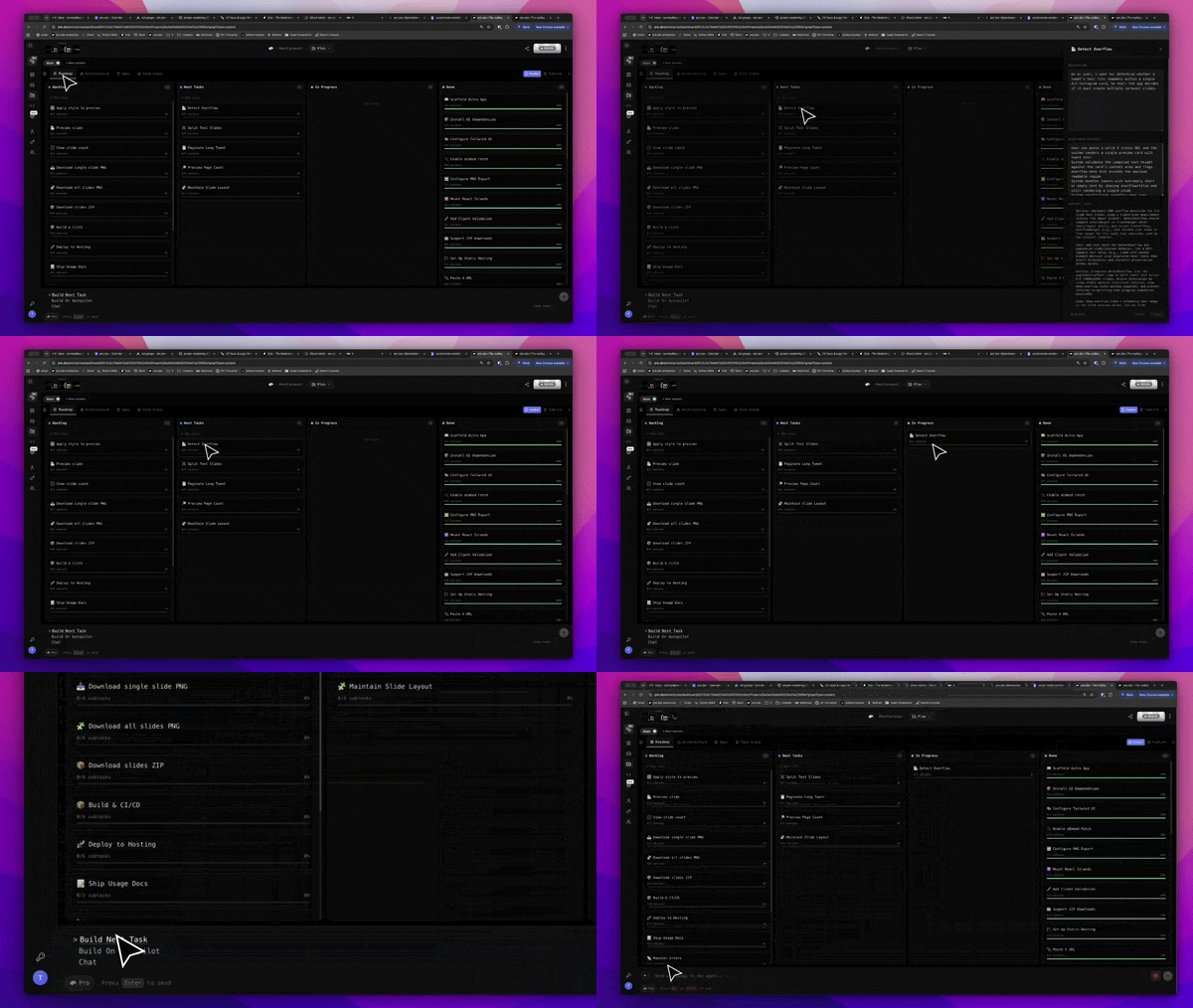
Once the Architect Agent has fully decompressed your idea, it automatically pipes the tasks into the native predev Kanban board. This board acts as your top-level control plane for your coding agents.
When planning large software projects for AI agents, Behavior-Driven Development and user stories are the gold standard for achieving predictable results.
The Architect Agent builds these user stories for you, structuring them into a framework detailing the persona (who), the action (what), the value (why), and a deterministic checklist of binary acceptance criteria.
An Example of an Agent-Ready User Story:
- As a returning shopper on the checkout page,
- I want to apply an alphanumeric promo code to my cart,
- So that I can see my order total update before finalizing the purchase.
By structuring tasks this way, the focus shifts to Verification over Implementation.
Why This Architecture Works: The Two Leverage Points
Understanding and utilizing this Kanban structure unlocks two massive leverage points for product creators:
1. A Unified Language for Humans and Agents
LLMs possess exceptional semantic comprehension. By feeding them well-structured user stories instead of rigid code instructions, you give them room to define the optimal how. This often results in elegant, novel architectural approaches you might not have considered. More importantly, it gives the agent a clear, binary checklist to automatically verify its own code before ever pushing a Pull Request (PR).
2. True Task Idempotency
Because well-scoped user stories exist independently of the volatile state of the codebase, they remain semantically stable. An agent can evaluate a single card on the Kanban board within the broader context of the system architecture without getting tripped up by concurrent changes happening elsewhere. This stability is vital for preventing agent drift.
Scaling to Autonomous Execution
This clean isolation allows you to completely parallelize your roadmap. You can tear individual user stories off your Kanban board and assign them to dedicated, isolated coding agents simultaneously. They work in their own cloud sandboxes and merge their completed features back via individual pull requests.
[ Raw Idea ]
│
▼
[ Architect Agent ]
│
▼
[ Kanban Control Plane ]
│
▼
⚡ (Parallel Execution)
├── [ Agent Sandbox 1 ] ➔ PR
├── [ Agent Sandbox 2 ] ➔ PR
└── [ Agent Sandbox 3 ] ➔ PR
This workflow gives you granular control, clear code attribution, and a bulletproof continuous integration pipeline. The underlying board framework acts as the shared memory that enables long-horizon agents to execute and verify their own work autonomously.
Beyond the Kanban board, predev provides additional levers to steer your agents at scale, including:
- Defining your core technology stack
- Modifying your global product specifications
- Fine-tuning agent execution profiles through customizable "skills"
- Spawning sub-agents for complex, multi-session builds
Ready to Build?
Head over to pre.dev to let the Architect Agent generate your professional roadmap, and start steering your coding agents from your own control plane.
Happy building.
Let Us Know Your Thoughts and Feature Requests
We want to hear from you! We are incredibly excited to see what you build and learn how you are using Multi-Session Builds to accelerate your projects. Join the conversation and share your feedback over on our X and LinkedIn pages.
What is predev? predev is an architecture-first, cloud-sandboxed coding agent that delivers autonomous, professional software development with integrated product management. By enforcing strict planning discipline, mapping out execution graphs, and running automated QA verification upfront, predev prevents codebase pollution and sustains a long-horizon autopilot for up to 60 plus hours straight without requiring developers to babysit a local terminal. The platform is completely model-agnostic to eliminate vendor lock-in, allowing teams to swap underlying infrastructure seamlessly. Most importantly, predev is engineered for true token efficiency within the harness layer, utilizing recursive memory compaction and tool optimization to deliver a 3x cost savings over generalist agents.