
pre.dev Browser Agents: Our First Labs Project is 3.4x Faster and 2.3x Cheaper Than Browser-Use
Introducing pre.dev labs browser agents. We are sharing our benchmark performance & some exciting use cased form our early access customers.

Table of Contents
- The Benchmark: pre.dev vs. browser-use
- Quality: A Perfect 100/100 Pass Rate
- Cost: 2.3x Cheaper at Scale
- Speed: 3.4x Faster Execution
- What You Can Build With Browser Agents
- Install pre.dev browser agents
- Why We Built This
- Eating Our Own Dog Food
- What is pre.dev labs?
The leverage of AI is real, but the compromise has been killing it. If you’ve spent the last year trying to build automated data pipelines or rely on web agents, you know exactly what I mean. You get 70% of the way there, and then you spend the rest of your time babysitting the AI and watching your token costs explode.
The next frontier of software development is orchestrating fleets of autonomous, parallel cloud agents. But you can't unlock true autonomy if your agents are slow, expensive, and hallucinate mid-task.
That’s why we are excited to announce pre.dev browser-agents, our first official project out of pre.dev labs.
Earlier this month, we released our proprietary, highly optimized agent harness for using AI to navigate, interact, and extract data from websites. This utility lets you run natural language instructions against any public URL and retrieve structured output without the friction.
The catch? We applied the most impactful optimizations from our native Self-Driving Agentic Engineering platform to achieve substantial benchmark improvements against the popular browser-usecloud peer.
Browser Agents by pre.dev is 3.4x faster and 2.3x cheaper, all while achieving a perfect pass rate for complex browser-related tasks—including multi-step navigation, login flows, form fills, pagination, “search to click and extract” chains, dynamic JS pages, anti-bot evasion, iframes, and CAPTCHA-protected sites.
This doesn't just enable the exciting use cases we’ve seen from our early access customers; it unlocks the cost-efficient scaling that most "the web is structured data" pitches conveniently ignore when handing you the bill.
The Benchmark: pre.dev vs. browser-use
We used 100 real-world web tasks to benchmark pre.dev browser-agents against the popular browser-use cloud API. The full head-to-head reproducible benchmark of browser automation services is open-sourced and available to audit.
Now, let's dive into the hard numbers.
1. Quality: A Perfect 100/100 Pass Rate
The success predicate was uniform across the board. The pass rate for the 100 tasks was 100/100 for pre.dev browser-agents, compared to 97/100 for browser-use cloud. These tasks weren't softballs; they included extracting data from Wikipedia, logging into secure websites, and pulling data out of complex iframes. The full list of tasks, prompts, and result schemas is published in our interactive benchmark report.

2. Cost: 2.3x Cheaper at Scale
Now for the economics. For the exact same set of 100 tasks, pre.dev browser-agents was 2.3x cheaper than browser-use.
For the entire test suite, the total added up to just $1.64 USD for pre.dev, compared to $3.70 USD for browser-use. The cost is captured from each provider's response payload (or estimated at published rates) using both pre.dev's and browser-use's cheapest, published tiers.
Think about this practically. When you are building large datasets or orchestrating parallel web agents, a 2.3x cheaper agent harness essentially cuts your massive API bill in half.

3. Speed: 3.4x Faster Execution
Lastly—and for many orchestrators, this is the most critical metric—speed. pre.dev runs 3.4x faster than browser-use. We are talking about averaging 9.0 seconds per task versus 30.6 seconds.
That is the difference between an agent needing one minute to complete a task versus three minutes. Scale that to hundreds of thousands of tasks running in parallel, and it fundamentally changes what you can build. For use cases where scale is relevant, the wall-clock time to complete a single task is just as important as the cost itself.

We encourage you to clone our GitHub repo, reproduce the test yourself, and start thinking critically about how to measure cost and speed once your systems actually start to scale. We have moved past simply asking what agents can do, and are now optimizing for massive scale at speed and efficiency.
What You Can Build With Browser Agents
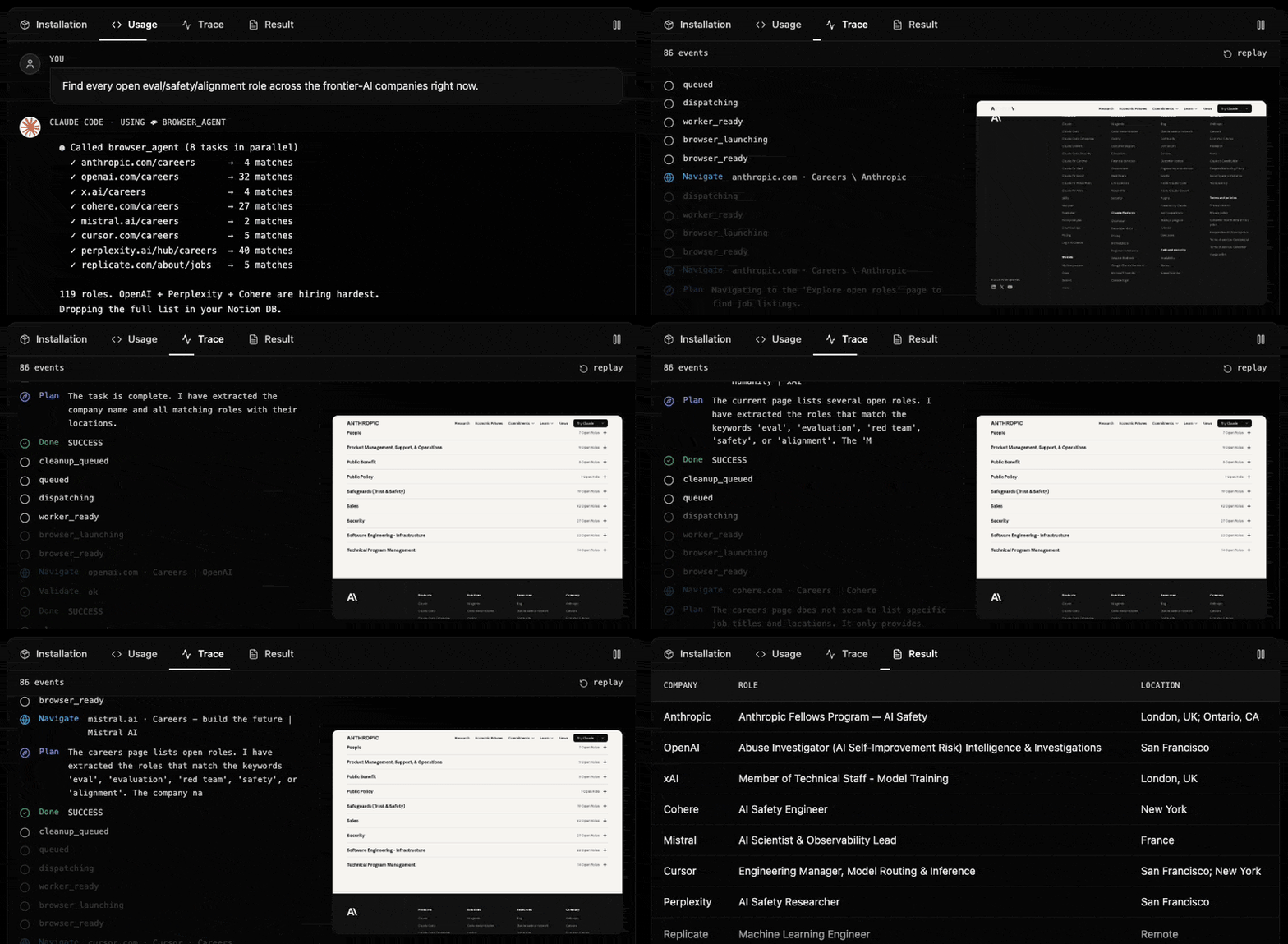
Where Browser Agents truly shines is in complementing large datasets with diverse web research or building web scraping pipelines from scratch.
Think of retrieving contact details and business addresses from a range of local businesses and piping that data directly into your CRM. You are dealing with many different websites in all shapes and sizes, with vastly different navigation options and DOM structures. Manually, this is a nightmare—especially for large datasets (think of scraping all Asian cuisine restaurants that offer takeout in the Bay Area). It is a task predestined for AI agents.
Yet, even with agents, speed matters. If your agent works linearly and sequentially like a human—albeit without pausing—you are still burning massive amounts of time. Having an agent harness run 3.4x faster than industry peers makes itself noticed immediately. Even more relevant is the halved cost that shows up on your monthly bill.
Or, for a simpler, everyday use case: think of that restaurant that is always fully booked. Run Browser Agents to snipe the reservation. Have it monitor the website, navigate the UI, and fill in the form the second a table becomes available.
Visit the pre.dev website for more real use cases from our customers.
Install pre.dev browser agents
Take pre.dev browser-agents for a spin and let us know what you think.
You can use it right now by adding the pre.dev MCP to Claude Code, or by utilizing our SDKs for Python and TypeScript. And of course, Browser Agents is fully available to use within our native Self-Driving Agentic Engineering platform on pre.dev.

Head over to our browser-agents documentation for our quickstart guide.
Why We Built This
We built Browser Agents because we simply weren't satisfied with the existing "vibe coding" solutions on the market. We had plans to add native web browsing to our platform for a while, but everything out there was far too expensive for what ultimately boils down to data and information retrieval.
Our customers frequently compliment the long token runway they get from the pre.dev platform due to our extensive context optimizations. We absolutely refused to integrate a browser utility that would just burn away our users' tokens on endless, synchronous loops.
So, we built it ourselves. We applied some immediate structural wins, like pre-processing files before loading them into the context window, and adding shorthand for recurring entities. More importantly, we sped up browser tasks by running them in parallel and routing easy tasks through a "fast path," only falling back to the heavy visual planner when absolutely necessary. Most providers lazily run the heavy visual planner on every single task, which is why they are slow and expensive. We are thrilled with the resulting 3.4x speed and 2.3x cost efficiencies.
Eating Our Own Dog Food
What really stood out to us while building this feature is how incredibly accessible it has become to write proprietary software using AI—if you have the right infrastructure.
We built the pre.dev browser-agents utility by using our own pre.dev platform and our native agents. This included the architecture, the token optimizations, the MCP integrations, and the entire benchmarking suite.
This was a great exercise in "eating our own dog food," but it also perfectly validated what we see our own customers doing with pre.dev every day. There is a massive trend toward in-house SaaS. While we don't see customers building their own massive CRM platforms (yet?), we see a surge of highly customized utilities being built. Developers are creating "glue software" that ties legacy systems together, transforming and piping data from proprietary sources into systems of record, and building internal tools like custom barcode scanners tied to bespoke inventory mappers.
The actual moat of your company is your business logic. Developers will use tools like pre.dev to compound their edge in that business logic, driving products to market with highly polished UIs in days instead of months.
What is pre.dev labs?
We are building pre.dev as an architecture-first agent harness in order to move the industry beyond micro-managing LLMs, and toward working with a true Self-Driving AI product team. No local setups or deep technical DevOps experience required. We focus on an ergonomic, browser-native platform that actually takes your projects over the finish line and ships them.
As part of this journey, we build a lot of internal tools to achieve the speed and token-efficiency we demand in our core product. With pre.dev labs, we want to share these tools as standalone services and elaborate on the R&D that goes into our platform.
Browser Agents is just the first project. To catch the next one, sign up for pre.dev, join our newsletter, or follow us on X and LinkedIn.
Sign Up to pre.dev for free and start using browser-agents
And please follow us on X or LinkedIn for more updates form pre.dev labs


